Showing posts with label permaculture. Show all posts

Sunday, September 16, 2012

Top 100: Clumping Herbs (Skirret)

This is the sixth of a series of posts that will cover the "Top 100" forest garden plants taken from volume 1 of the Edible Forest Gardens books. In this post we begin our list of clumping herbs.


Skirret — Sium sisarum
Hardiness zone 5-9, full sun to part shade, clumping, 3 ft. x 1-2 ft., edible roots, specialist nectary (image above)

Skirret is a productive root crop and specialist nec­tary plant for the sunnier parts of the forest garden. Its roots have long been cultivated in Eurasia but fell out of favour in the twentieth century. This is probably because the pencil- to finger-thick tap­roots, which grow as a dense cluster, often have a fibrous or woody core, at least in unnamed varieties. Fortunately, improved varieties that entirely lack this trait are now available and can be vegetatively propagated. The cooked roots are sweet and filling, like a blend of parsnip and potato. This productive and low-maintenance vegetable may enjoy a renais­sance as we come to appreciate the role of multi­purpose perennials in forest gardens and other edible landscaping systems.

Sweet Goldenrod - Solidago odora
Hardiness zone 3, full sun to part shade, clumping, 2-4 ft. x 2-4 ft., edible tea, specialist nectary

Goldenrods are ubiquitous species in the oldfield stage of succession throughout the eastern forest region. As a group, goldenrods are important for beneficial insects as a fall nectar source and a place to aggregate and then spread into the garden. Sweet goldenrod has the added benefit of being one of our finest native tea plants. Blue mountain tea, a beverage made from the leaves and flowers, has a licorice-like flavor. The leaves also make a nice nibble. As goldenrods go, this species is not very aggressive, mostly staying in place as a clump. A few sweet goldenrods in the sunnier phases or areas of your garden will provide many benefits with little care.

Comfreys (Symphytum spp.)

Large-flowered Comfrey - Symphytum grandiflorum
Hardiness zone 4, full sun to part shade, clumping, 8-12 in. x 18 in., dynamic accumulator, ground cover, beneficial habitat

Russian Comfrey - Symphytum x uplandicum
Hardiness zone 6, full sun to part shade, clumping, 1-4 ft. x 3 ft., dynamic accumulator, beneficial habitat (image below)

Comfreys are fantastic functional plants for the forest garden. They are perhaps the best of all the dynamic accumulators. They grow extremely well in most conditions, and you can cut them for nutrient-rich mulch several times each season. They also excel at attracting beneficial insects, pro­viding a preferred egg-laying and overwintering site for many species. Comfreys are also beloved by spiders, hosting as many as 240 per square meter in the soil below them during winter, according to one study. The challenge is that comfreys are incredibly persistent—once planted, they are virtually impos­sible to eliminate. A tiny root piece left in the ground will start a new plant. In addition, the species most commonly grown spreads by seed. Comfrey has taken over many gardens—don't let it happen to you!

One way to avoid this is to plant Russian com­frey, a sterile hybrid of two species, meaning it cannot make viable seed and, thus, cannot be weedy by seed. It is just as persistent as the common species, however. Large-flowered comfrey is a ground-covering species that forms a low mound. It will spread vegetatively and to a certain degree by seed. Large-flowered comfrey is a fantastic soil-building ground cover for partial shade.

Sunday, August 26, 2012

Top 100: Running Herbs (Yarrow)

This is the fifth of a series of posts that will cover the "Top 100" forest garden plants taken from volume 1 of the Edible Forest Gardens books. In this post we finish our list of running herbs.


Yarrow - Achillea millefolium
Hardiness zone 3, full sun to part shade, running, 8-36 in. x indefi­nitely spreading, ground cover, dynamic accumulator, beneficial habitat, specialist nectary (image above)

This low-maintenance workhorse is one of the pre­mier multipurpose support plants for the forest garden. It forms clumps but sends out vigorous runners to form new clumps. Many assume that yarrow is in the Apiaceae, due to its umbel-shaped heads, but it is in fact a member of the aster family (Asteraceae). Regardless, it is a fine specialist nec­tary plant. It also provides foliage habitat and egg-laying sites for ladybugs, spiders, lacewings, Carabid beetles, and parasitoid insects. It dynamically accumulates phosphorus and potassium, among other nutrients, and, of course, it is a pop­ular ornamental, drought tolerant, and medicinal too! Although a bit aggressive, yarrow has much to offer as a multifunctional plant for the edible forest garden.

Pink Tickseed - Coreopsis rosea
Hardiness zone 3-9, full sun, running, 1-2 ft. x indefinitely spreading, ground cover, specialist nectary

This native wildflower is a popular and attractive ornamental and a low-maintenance, multipurpose forest-garden plant. It forms a moderately dense ground cover and spreads rapidly. This specialist nectary blooms profusely from July to September, providing much fuel for beneficial insects. Growing the wild type, rather than named cultivars, may provide the highest nectar yield for beneficials, as plant breeding for ornamental qualities often unin­tentionally decreases nectar production by flowers. Note that the related clumping Coreopsis species are also fine choices for the forest garden.

Jerusalem Artichoke - Helianthus tuberosus
Hardiness zone 2, full sun to part shade, running, 6-12 ft. x indefi­nitely spreading, edible roots (image below)

This enormous perennial sunflower relative is among our best native wild edibles. Jerusalem arti­chokes produce truly enormous quantities of tubers. They are generally somewhat smaller than potatoes and taste crisp and sweet. Jerusalem arti­choke is one of the few commercially grown peren­nial vegetables, and one of the very best low-maintenance food crops for our climate. For some people the roots can cause flatulence, partic­ularly when eaten raw. Keep trying; your body will adjust if you eat them frequently. Jerusalem arti­choke grows in dense stands. Either respect it and give it plenty of room to spread, or fence it in with rhizome barriers. Dwarf varieties may be somewhat more manageable, or at least less competitive. Annual harvesting invigorates the plants and leads to higher yields. Jerusalem artichoke has a reputa­tion for being quite persistent, even weedy, but apparently if you uproot the plants in July when they are flowering, they will not come back. At least not as much!

Daylily - Hemerocallis spp.
Hardiness zone 2 or 3, full sun to part shade, running, 1-5 ft. x indefinitely spreading, edible flowers, buds, and tubers

Daylilies certainly have a role to play in the forest garden, although contemporary landscaping clearly overuses them. The flowers and flower buds are a popular vegetable in northern Asia, and those in the know in the United States and Canada eat them, too. The tubers are also edible, and quite pro­ductive. They can cause a bit of digestive upset for those who are not accustomed to them, so use them with caution. Daylily does not fit this book's defi­nition of a ground cover (it is too tall), but it is a great ground cover nonetheless. The challenge is that daylilies are too large and vigorous to be a good companion to most herbs. Daylilies are a good low-maintenance choice for an area of your garden to which you don't want to have to pay any attention.

Tuesday, August 7, 2012

Top 100: Running Herbs (Giant Solomon's Seal)

This is the fourth of a series of posts that will cover the "Top 100" forest garden plants taken from volume 1 of the Edible Forest Gardens books. In this post we start our list of running herbs.


Giant Solomon's Seal - Polygonatum biflorum var. commutatum
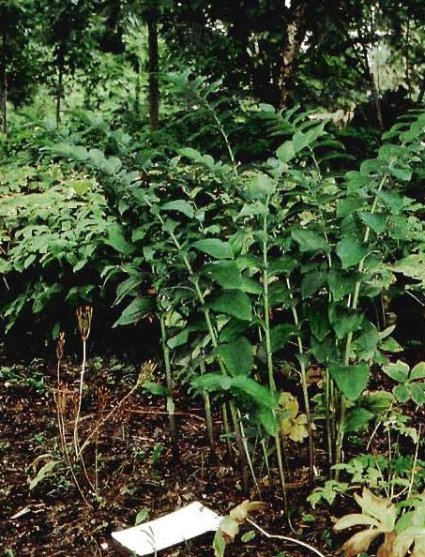
Hardiness zone 3, full sun to part shade, running, 3-5 ft. x indefinitely spreading, edible shoots (image above)

This beautiful, native wildflower of the lily family sends up slender 3 to 5 foot (0.9 to 1.6 m) stalks in drifts and spreads by rhizomes. It is commendable for its adaptability—giant Solomon's seal grows in full sun all the way to full shade. Cut and use its edible shoots in the spring, like asparagus; they taste quite good, though the leaf cluster at the top of the shoot may taste somewhat bitter. Giant Solomon's seal is another example of an underutilized native that is highly adapted to the forest garden model.

Ostrich Fern - Matteuccia struthiopteris
Hardiness zone 2, part to full shade, running, 4-6 ft. x indefinitely spreading, edible shoots

Each spring, markets in New England offer the strange, tightly curled shoots of ostrich fern, known as fiddleheads. This is one of the most well-known and beloved native wild edibles of the eastern forest. It is also an attractive ornamental, reaching 4 to 6 feet (1.2 to 1.8 m) or more and forming extensive colonies in moist soil and part to full shade. The distance between crowns leaves room for low-growing, shade-tolerant companions. Steam or boil the fiddleheads for at least ten minutes to remove toxins. They taste delicious when boiled and served with butter.

Mints - Mentha spp.
Hardiness zone 3, full sun to part shade, running, 1-3 ft. x indefinitely spreading, edible tea, culinary, aromatic

The numerous species and hybrids of mint are highly adapted for the forest garden. They were among the most prevalent understory species in Robert Hart's garden. Unfortunately, as he was quick to admit, they were among the more troublesome weeds in his garden as well. Mints tend to be vigorous runners, colonizing new areas but never staying in one area for too many years. They will outcompete many other herbs, except for large, tough, well-established dumpers. Their foliage is wonderful in teas, fresh or dried, and in small amounts in salads. The flowers are excellent generalist nectaries, attracting many beneficial insects, and the strong scent of the foliage confuses pests in their search for their favorite foods. A new cultivar called 'Marilyn's Salad Mint' is said to have milder-flavored leaves and is a promising new running perennial vegetable for partial shade.

Chinese Artichoke - Stachys affinis
Hardiness zone 5, full sun to part shade, running, 18 in. x indefinitely spreading, edible tubers

This running ground cover is in the mint family. It is native to eastern Asia, but people now grow it throughout the cold climates of the world. It produces small (1 inch/3 cm) tubers, in good quantity. The tubers are crisp, with a light mint flavor, but they are also bumpy and somewhat difficult to clean. They taste good raw in salads and can be cooked in a variety of ways. Chinese artichoke makes a moderately dense cover. Annual harvest results in higher yields. Harvest all you can find, because enough will always elude discovery to ensure a vigorous stand the following year.

NETTLES (Laportaea AND Urtica SPP.)

Wood Nettle - Laportaea canadensis
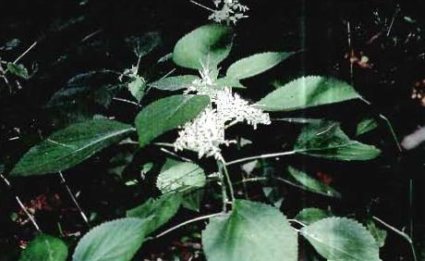
Hardiness zone 3, part to full shade, running, 1-3 ft. x indefinitely spreading, edible leaves (image below)

Stinging Nettle - Urtica dioica
Hardiness zone 4, full sun to part shade, running, 3-4 ft. x indefinitely spreading, edible leaves, dynamic accumulator

Nettles in a forest garden? Why would we welcome a plant that causes painful stings? Believe it or not, nettles are among the most beneficial plants for the forest garden. For starters, both of these closely related species produce delicious and hearty greens—when cooked (make sure to harvest with gloves on). Even a minute of steaming is enough to deactivate the sting. If you have never had them, the delightful taste of the greens will surprise you. Both plants form large colonies through seed and rhizomes. Use rhizome barriers, and be sure to locate your nettles where you will not accidentally brush against them.

Stinging nettle is one of the most nutritious leafy greens in the world, as well as being a fabulous dynamic accumulator and a wonderful compost plant. Research indicates that it increases the volatile oil content of herbs grown alongside it, making them more aromatic. Stinging nettles have naturalized in most of the United States, often in situations closely resembling forest gardens. The variety gracilis is native to North America. Our native wood nettle is also a delicious potherb and may be a dynamic accumulator like its cousin. Wood nettle grows in full shade and seems to thrive in the understory of old-growth forests.

Monday, July 23, 2012

The Founders on Agriculture (part 2)

This post continues from part 1 of this series. Here the Founders delve into the spiritual aspects of growing food and building a community.


Use prayer, meditation, and higher consciousness techniques to raise the yield and quality of your produce. The Findhorn community in Scotland is a prime example of this. For years, they have had the best produce in Europe, even though their soil and water are just average. This has been attributed to prayer and mindfulness, as well as harmonious and joyful living.

If you can, talk to the plants. Commune with them. Learn to telepath. It might be easier than you think.

Although you will not grow enough to feed the entire world, learn to be generous with your neighbors. Use protection to keep thieves at bay. Send love and compassion to those in the cities that are having trouble finding food, but set your intention to become psychologically invisible to anyone who would steal your crops or farm equipment. Erect an etheric dome of golden, loving light around your farm and those of your neighbors.

Have regular community meetings with everyone in the area. Propose a purpose of the meetings, such as, "We have gathered together to assist each other in a bountiful harvest, and to share ideas and insights on how to grow better crops."

Talk to the nature spirits. They will often know what kind of winter is coming, or whether a particularly exotic fruit will flourish or die in your temperate climate. Devote small portions of your farm to crops that your intellect might say you are crazy to plant, but for which your inner guidance says go ahead.

Balance your time between farming, family and spiritual practice. This is not easy, since farming can be quite labor intensive. Share your talents and abilities in a balanced way with others. You might not be the farmer, but you might have the money to buy the property. That might be your primary contribution to the community. Everyone has unique sets of talents and abilities. Encourage souls to express their latent, as well as obvious, abilities. Ask for what you truly need.

Visualize a community that has a balance of talents and abilities, so that you attract one person who is good at plumbing, another who has an electrical wiring background, another who can purchase and install solar panels, etc., instead of attracting 100 plumbers and no electricians.

You want a balance between highly grounded souls who work with their hands and the Earth, and those who are more visionary and mental. Both are needed for a successful enlightened farming community. You will need some administrators and those who are natural leaders, but you do not want everyone trying to be the boss.

Monday, July 16, 2012

Top 100: Prostrate Herbs (Wild Ginger)

This is the third of a series of posts that will cover the "Top 100" forest garden plants taken from volume 1 of the Edible Forest Gardens books. In this post we finish our list of prostrate herbs.


WILD GINGER (Asarum SPP.)

Wild Ginger - Asarum canadense
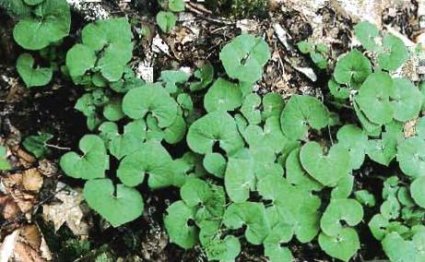
Hardiness zone 3, part to full shade, running mat former, 4-8 in. x indefinitely spreading, ground cover, edible root (image above)

Shuttleworth's Wild Ginger — Asarum shuttleworthii
Hardiness zone 6, part to full shade, evergreen clumping mat former, 4-8 in. x 14 in., ground cover

Wild ginger is one of our best native ground covers. These dense, low-growing species spread indefinitely. They make lovely ornamentals, especially evergreen species such as Shuttleworth's wild ginger. The roots of some species, including wild ginger, supposedly substitute for cultivated ginger. In our experience, the flavor is not nearly as pleasant as that of ginger—it has a bit of a medicinal flavor. Nevertheless, wild gingers are an outstanding choice for a native shade-loving ground cover.

Green and Gold - Chrysogonum virginianum
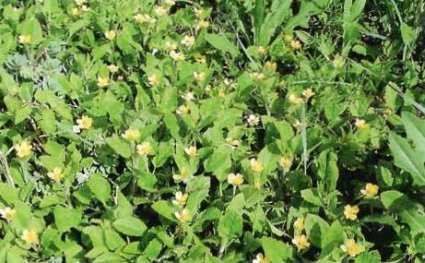
Hardiness zone 4, full sun to part shade, evergreen clumping mat former, 3-6 in. x 18in., specialist nectary, ground cover (image below)

Also known as golden star, this is another fantastic native ground cover. While not fast growing, this slow and steady mat former is a reliable low-maintenance species for sun to partial shade. It forms low, dense evergreen mats that are covered by beautiful yellow daisylike flowers in spring and early summer. Goldenstar flowers in the early part of the year—the crucial period when the forest garden needs beneficial insects but few other specialist nectaries are available. This trait, combined with green and gold's excellence as a ground cover, makes it a great choice for forest gardens.

STRAWBERRIES (Fragaria SPP.)

Garden Strawberry - Fragaria X ananassa
Hardiness zone 3, full sun, evergreen running, 6-12 in. x indefinitely spreading, edible fruit, ground cover

Beach Strawberry - Fragaria chiloensis
Hardiness zone 7, full sun, evergreen running, 6 in. x indefinitely spreading, edible fruit, ground cover

Musk Strawberry - Fragaria moschata
Hardiness zone 5, full sun to part shade, evergreen running, 6-12 in. x indefinitely spreading, edible fruit, ground cover

Alpine Strawberry - Fragaria vesca alpina
Hardiness zone 3, full sun to part shade, evergreen clumping, 10 in. x 10 in., edible fruit

Wild Strawberry - Fragaria virginiana
Hardiness zone 4, full sun to part shade, evergreen running, 4-12 in. x indefinitely spreading, edible fruit, ground cover

As a group, strawberries generally make excellent edibles and only moderate ground covers. They are well suited to sunny pockets of production or to being interwoven with clumping species in polycultures. Most spread indefinitely as runners and are self-pollinating. A few varieties do require a pollinator.

Beach strawberry is native from California to Chile on the Pacific coast. Fruit quality is allegedly good but not great. Unlike most strawberries, it makes a dense, evergreen ground cover. Unfortunately, it is not very hardy. Musk strawberry is an underutilized species that, while not very productive, bears delicious fruit said to taste of raspberry and pineapple. Alpine strawberry is unusual in that it forms a single clump and does not spread. It is a great candidate for the edges of garden pathways because it ripens just a few small fruit at a time, but does so throughout the growing season. Thus if you walk by every day you can make the most of what it has to offer—and there is more strawberry flavor packed into one of these tiny fruits than in any number of enormous store-bought hybrids! Wild strawberry, our native wild species, bears small, sweet fruits. It is not much of a ground cover, but it intermingles well with grasses and wildflowers in meadows here in New England. We could use it similarly in the forest garden. Garden strawberry is the common cultivated form, a hybrid of several of the above species. You can't beat it for productivity, and many cultivars have excellent flavor. This is a perfect species for pockets of production, but it might want to have its patch rotated every few years for disease prevention. Strawberry-rhubarb pie is sure to be a favorite product of the forest garden!

Galax - Galax urceolata
Hardiness zone 4, part to full shade, evergreen running, 6-12 in. x indefinitely spreading, ground cover

This native evergreen ground cover is an excellent choice for forest gardens with some shade. It spreads, but not overly vigorously, forming a dense colony of tight clumps. Galax is another underutilized native deserving of attention. We are happy it is becoming more available as an ornamental.

Sunday, July 1, 2012

The Founders on Agriculture (part 1)

In chapter 4 of the book "Earth Awakens: Prophecy 2012 - 2030" the Founders provide some practical recommendations on the number one investment priority for making the transition to the Golden Age: buying land and growing food.


If money is no concern, buy a piece of land mid-way between the flood plain and the mountains, import several tons of minerals, add these and a lot of compost to the soil, and begin planting. Focus on variety, for two reasons: (1) your body will get a variety of nutrients; and (2) if some of the crops fail due to erratic weather patterns or unforeseen pests, others will thrive.

Since many areas of the planet are getting warmer, buy your land in a temperate zone (away from the tropics) and then add some subtropical or tropical items to your temperate crops. You might be surprised, for example, that avocados, citrus, figs and mangoes might just make it north of southern California and Florida.

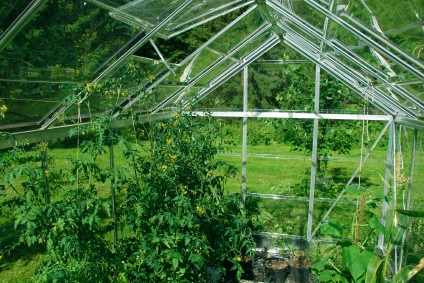
Use the latest greenhouse and hydroponics technologies. Read all about permaculture.

Learn how to properly store foods during inclement years. Do research on which storage materials are best. Make sure you select containers that do not release toxic chemicals during extreme heat or cold.

Practice living in harmony with beneficial and harmful insects, including parasites. Bless the creatures that prey on your crops and visualize golden light protecting your land and keeping it safe from predators.

Support your local heirloom seed bank. As GMO crops continue to proliferate, it will become harder to find uncontaminated seeds (due to cross-pollination).

Know your local farmer, or be your local farmer. If you know the farmers in a 100km radius to your own land, you can trade, barter, volunteer and get involved in each other's farming projects. If you get wiped out by hail, probably others will have crops that survive and you can assist the farmers that have the good yields and be rewarded with their surplus. If you are the fortunate one, be willing to feed those whose crops get ruined. Maybe one year the hailstorm will hit your field and everyone helps you, and the next year it will hit your neighbor's field and you can return the favor.

If some of your neighbors are not informed about the hazards of GMO crops, do your best to educate them. There are volumes of literature detailing the problems with such crops. If one of your neighbors insists on continuing the GMO practice, you will need to cover or otherwise protect your crops from cross-pollination.

Monday, June 25, 2012

Top 100: Prostrate Herbs (Miner's Lettuce)

This is the second of a series of posts that will cover the "Top 100" forest garden plants taken from volume 1 of the Edible Forest Gardens books. We started with the fungi and are now up to the prostrate herbs. There are a lot of useful ones so this is only the start of the list.


MINER'S LETTUCE (Montia SPP.)

Miner's Lettuce - Montia perfoliata
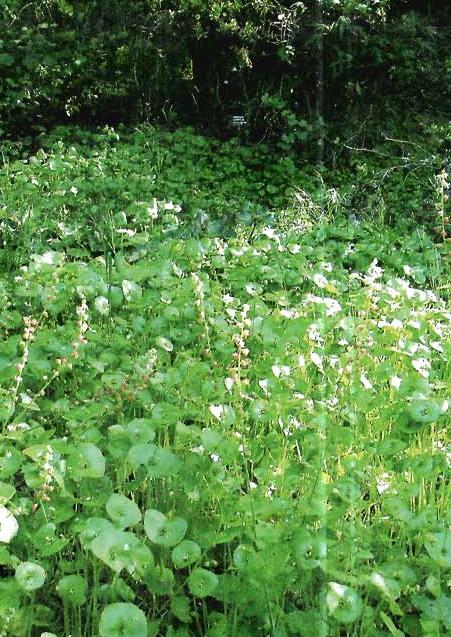
Hardiness zone 4, full sun to part shade, clumping, self-seeds, 6-12 in. x 6-12 in., edible leaves, ground cover (image above)

Siberian Miner's Lettuce - Montia siberica
Hardiness zone 4, full sun to part shade, clumping, self-seeds, 8-12 in. x 8-12 in., edible leaves, ground cover

Greg Tilford, in his excellent Edible and Medicinal Plants of the West, says, "Of all edible [wild] plants, miner's lettuce stands out as one of the most palatable . . . the leaves and stems of this group of plants taste almost identical to lettuce . . . Miner's lettuce stays tender and sweet throughout its growth cycle." In addition to its delectable status, miner's lettuce makes a fine ground cover in moist soils with partial to very dense shade. Both species listed here are native to western North America. Miner's lettuce is an annual or short-lived perennial that self-sows to form a dense carpet. This species is cultivated commercially as a salad green with a truly delicious flavor. It tolerates somewhat dry soils, unlike Siberian miner's lettuce, a clumping perennial that spreads freely by seed. Its leaves taste good, except when the plant is flowering.

Foamflower - Tiarella cordifolia
Hardiness zone 3, part to full shade, running, 6-12 in. x indefinitely spreading, ground cover, specialist nectary

This beautiful shade-loving plant is one of our best native ground covers. It forms attractive clumps and drifts, spreading indefinitely. Foamflower is a specialist nectary, attracting beneficial insects in spring. You can find foamflower in rich woods throughout our region.

White Clover - Trifolium repens
Hardiness zone 4, full sun to part shade, running, 4-10 in. x indefinitely spreading, fixes nitrogen, ground cover, edible leaves

This tireless workhorse deserves a place in virtually every forest garden. It is a fine candidate for sunny pathways, as it will tolerate substantial foot traffic. It is (somewhat) edible, and it fixes nitrogen like a champ. The stems creep and root as they go, forming mats. White clover is well suited as a ground-covering polyculture companion to accompany crop shrubs or larger herbs. It is a good generalist nectary and a preferred cover and egg-laying site for many beneficial insects. Unlike many forest garden species, white clover is widely available. You can easily start it from seed right in the ground where you want it. Inoculate to ensure nitrogen fixation.

VIOLETS (Viola SPP.)

Canada Violet - Viola canadensis
Hardiness zone 4, full sun to part shade, running, 6-16 in. x indefinitely spreading, edible leaves and flowers

Labrador Violet - Viola labradorica
Hardiness zone 3, full sun to part shade, evergreen running, 4 in. x indefinitely spreading, edible leaves and flowers

Sweet Violet - Viola odorata
Hardiness zone 4, full sun to part shade, evergreen running, 6-8 in. x indefinitely spreading, edible leaves and flowers

These attractive little flowers are excellent under-story species for forest gardens. All have edible leaves and flowers, but let us warn you, some taste much better than others do. As a rule, yellow-flowering types have more bitterness. Nonetheless, good-tasting violets exist for almost any site condition you may have. We have listed only a few; learn your own native species! In addition to the runners profiled here, there are also many nice clumping types. Labrador violet, from chilly northern New England and Canada, makes an excellent ground cover: it is semievergreen, dense, and matlike. Unfortunately, the somewhat woolly leaves are not particularly palatable. Sweet violet makes a good, vigorous, evergreen ground cover. The leaves are by far the sweetest of any violet we have tried. It functions best in areas free of scorching hot summers. Canada violet is a fine native with good-flavored leaves and flowers.

Barren Strawberry - Waldsteinia fragarioides
Hardiness zone 4-7, full sun to part shade, evergreen running, 4-8 in. x indefinitely spreading, ground cover

Barren strawberry is another fantastic native ground cover. It spreads rapidly and forms a dense carpet, and it is one of the best evergreen ground covers for full sun. The plants closely resemble strawberries, to which they are closely related, but their small, green fruit is not edible.

Monday, May 28, 2012

Top 100: Fungi

This is the first of a series of posts that will cover the "Top 100" forest garden plants taken from volume 1 of the Edible Forest Gardens books. We will start with the fungi and work our way up to the trees. In Anastasia book 4 chapter 14, Vladimir mentions mushrooms briefly.


Russians are accustomed to eating mushrooms - well boiled, fried, marinated or salted. Anastasia eats them in their dried, natural state, without any processing. One time I was travelling from Moscow to Gelendzhik by car for a readers' conference. The whole trip I lived on mushrooms Anastasia had given me.

We now take a look at the 4 species of mushrooms listed in the "Top 100".


Shiitake - Lentinula edodes
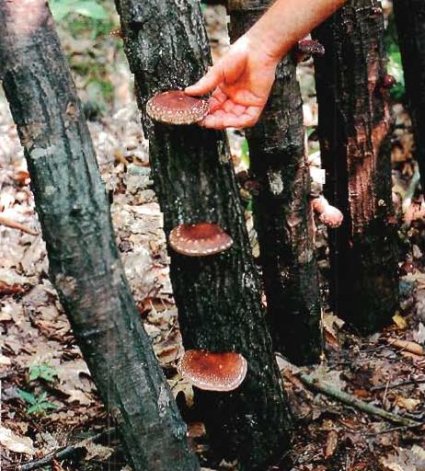
Many farmers and gardeners in our region grow shiitake mushrooms. Their cultivation is fairly simple and reliable. Shiitakes will grow on logs or stumps. Their rich flavor and firm texture make shiitakes a popular gourmet mushroom. Many Asian cultures also consider them medicinal. (image above)

Oyster Mushroom - Pleurotus ostreatus
Oysters grow easily in a variety of substrates. Cultivators usually grow them on logs or stumps, but they can also grow in compost piles, straw mulch, or almost any carbonaceous material. They are voracious decomposers and are even used to clean up and digest toxic oil spills. Their gourmet flavor does, in fact, resemble that of oysters.

Chicken-of-the-Woods - Polyporus sulphureus
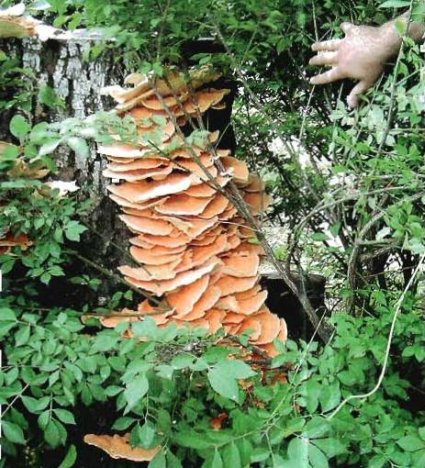
Chicken-of-the-woods mushrooms provide exceptional quality food. They exhibit a Day-Glo orange color and actually do taste just like chicken. Chicken-of-the-woods grows best on stumps but can also grow on partially buried logs. (image below)

King Stropharia - Stropharia rugoso-annulata
King stropharias are large, gourmet mushrooms. Their flavor resembles that of potatoes cooked with wine. Stropharias are well suited to cultivation in straw or wood-chip mulch—in fact, they commonly pop up uninvited in bark mulch used for landscaping. When overmature, the caps can exceed 12 inches (30 cm) in diameter.

Monday, May 14, 2012

Edible Forest Gardens

In Anastasia's vision of a Home she provides a brief explanation of how to grow an edible forest garden, and with just that information one could be grown. However, for those looking for a detailed reference, you need look no further than the "Edible Forest Gardens (2 volume set)".

The author, Dave Jacke, has also set up a web site with plenty of information to get you started. Here is an excerpt introducing his vision.


Picture yourself in a forest where almost everything around you is food. Mature and maturing fruit and nut trees form an open canopy. If you look carefully, you can see fruits swelling on many branches—pears, apples, persimmons, pecans, and chestnuts. Shrubs fill the gaps in the canopy. They bear raspberries, blueberries, currants, hazelnuts, and other lesser-known fruits, flowers, and nuts at different times of the year. Assorted native wildflowers, wild edibles, herbs, and perennial vegetables thickly cover the ground. You use many of these plants for food or medicine. Some attract beneficial insects, birds, and butterflies. Others act as soil builders, or simply help keep out weeds. Here and there vines climb on trees, shrubs, or arbors with fruit hanging through the foliage—hardy kiwis, grapes, and passionflower fruits. In sunnier glades large stands of Jerusalem artichokes grow together with groundnut vines. These plants support one another as they store energy in their roots for later harvest and winter storage. Their bright yellow and deep violet flowers enjoy the radiant warmth from the sky. This is an edible forest garden.

What is Edible Forest Gardening?
Edible forest gardening is the art and science of putting plants together in woodlandlike patterns that forge mutually beneficial relationships, creating a garden ecosystem that is more than the sum of its parts. You can grow fruits, nuts, vegetables, herbs, mushrooms, other useful plants, and animals in a way that mimics natural ecosystems. You can create a beautiful, diverse, high-yield garden. If designed with care and deep understanding of ecosystem function, you can also design a garden that is largely self-maintaining. In many of the world's temperate-climate regions, your garden would soon start reverting to forest if you were to stop managing it. We humans work hard to hold back succession—mowing, weeding, plowing, and spraying. If the successional process were the wind, we would be constantly motoring against it. Why not put up a sail and glide along with the land's natural tendency to grow trees? By mimicking the structure and function of forest ecosystems we can gain a number of benefits.

Why Grow an Edible Forest Garden?
While each forest gardener will have unique design goals, forest gardening in general has three primary practical intentions:
  • High yields of diverse products such as food, fuel, fiber, fodder, fertilizer, 'farmaceuticals' and fun;
  • A largely self-maintaining garden and;
  • A healthy ecosystem.
These three goals are mutually reinforcing. For example, diverse crops make it easier to design a healthy, self-maintaining ecosystem, and a healthy garden ecosystem should have reduced maintenance requirements. However, forest gardening also has higher aims.

As Masanobu Fukuoka once said, "The ultimate goal of farming is not the growing of crops, but the cultivation and perfection of human beings." How we garden reflects our worldview. The ultimate goal of forest gardening is not only the growing of crops, but the cultivation and perfection of new ways of seeing, of thinking, and of acting in the world. Forest gardening gives us a visceral experience of ecology in action, teaching us how the planet works and changing our self-perceptions. Forest gardening helps us take our rightful place as part of nature doing nature's work, rather than as separate entities intervening in and dominating the natural world.

Where Can You Grow an Edible Forest Garden?
Anyone with a patch of land can grow a forest garden. They've been created in small urban yards and large parks, on suburban lots, and in small plots of rural farms. The smallest we have seen was a 30 by 50 foot (9 by 15 m) embankment behind an urban housing project, and smaller versions are definitely possible. The largest we have seen spanned 2 acres in a rural research garden. Forest gardeners are doing their thing at 7,000 feet (2,100 m) of elevation in the Rocky Mountains, on the coastal plain of the mid-Atlantic, and in chilly New Hampshire and Vermont. Forest gardening has a long history in the tropics, where there is evidence of the practice extending over 1,500 years. While you can grow a forest garden in almost any climate, it is easiest if you do it in a regions where the native vegetation is forest, especially deciduous forest.

Edible forest gardening is not necessarily gardening in the forest, it is gardening like the forest. You don't need to have an existing woodland if you want to forest garden, though you can certainly work with one. Forest gardeners use the forest as a design metaphor, a model of structure and function, while adapting the design to focus on meeting human needs in a small space. While you can forest garden if you have a shady site, it is best if your garden site has good sun if you want the highest yields of fruits, nuts, berries, and most other products. Edible forest gardening is about expanding the horizons of our food gardening across the full range of the successional sequence, from field to forest, and everything in between.

In Volume One: Vision and Theory, there is a list of the "Top 100" forest garden plants, so over many future posts I will present a description of all of those plants.

Thursday, April 26, 2012

Faeries, Devas and Findhorn

In the book "Earth Changes and 2012", the Founders talk a bit about the Faerie and Elemental realms.


As Earth ascends, you will be drawn closer to what this channel (Sal Rachele) calls the "higher etheric realms." This is where the nature spirits, faeries, sprites, devas and other fairy folk dwell. As you increase your vibration and expand your consciousness, you will become aware of the spirits that are all around you. While it is possible to become more aware of the lower and middle astral realms, those realms will have less and less appeal to you as you move into etheric consciousness. Instead, you will be drawn to the loving and kind spirits of the higher astral and etheric planes, including most of the faeries and devas. You can call upon these helpers to assist you in feeling closer to the Earth. They will help you anticipate climate changes and where you should be physically for the greatest comfort and joy. They will help you grow your gardens and find good drinking water. They are Earth specialists. They help the Earth herself move into fourth density.

Perhaps the most famous example of what the Founders describe happened at the Findhorn Ecovillage in Scotland during the 1960's.


Co-creation with Nature

Eileen and Peter Caddy and Dorothy Maclean all followed a disciplined spiritual practice for many years before they came to live at Findhorn, and they continued their regular meditation times when they came to live at the caravan park.

In May, 1963 Dorothy Maclean received an insight from within as she meditated:

. . . The forces of nature are something to be felt into, to be reached out to. One of the jobs for you as my free child is to sense the Nature forces such as the wind, to perceive its essence and purpose for me, and to be positive and harmonise with that essence.

When Dorothy shared this insight with Peter, his idea was to apply to their fledgling garden what Dorothy learned from the forces of nature. Dorothy then received this insight:

Yes, you can cooperate in the garden. Begin by thinking about the nature spirits, the higher overlighting nature spirits, and tune into them. That will be so unusual as to draw their interest here. They will be overjoyed to find some members of the human race eager for their help.

Angels, devas and elemental beings

Dorothy first attuned to the garden pea. As her communication with the forces of nature developed, Dorothy realised that she was in contact not with the spirit of an individual plant, but with the ‘overlighting’ being of the species, which was the consciousness holding the archetypal design of the species and the blueprint for its highest potential. She was experiencing a formless energy field for which there is no word. The closest word to convey the joy and purity that these beings emanated was the inaccurate word ‘angel’ (which in the west is full of form), and her first thought was to call them that. However, the Sanskrit term ‘deva’, meaning ‘shining one’ seemed more accurate and freer of cultural associations. In practice, she uses both words, although neither word is adequate. Peter and Dorothy applied the insights of the meditations to their work in the garden, and through this the Findhorn garden flourished. These were the first steps in the Findhorn Community’s co-creation with nature.

Monday, April 2, 2012

Transition Towns

A clear message from both Anastasia and the Founders is the need to become more self-sufficient in order to facilitate your journey into the Golden Age. Suddenly moving to an ecovillage or intentional community when all you've known your whole life is city living would likely be too much of a shock for most people. So we need a way to ease ourselves into self-sufficient living and the Transition Towns movement does exactly that.

For some background on the movement, you can read the Wikipedia page on Transition Towns. For the main hub of the movement see the Transition Network home page. The Transition Initiatives Map provides an easy way to discover if the city you live in has started an initiative, and if not you can start one yourself! I'm a member of Transition Ottawa which has over 500 members. The Transition US hub has a nice description of the movement as quoted below.


The Transition Town Movement

The Transition Movement is comprised of vibrant, grassroots community initiatives that seek to build community resilience in the face of such challenges as peak oil, climate change and the economic crisis. Transition Initiatives differentiate themselves from other sustainability and "environmental" groups by seeking to mitigate these converging global crises by engaging their communities in home-grown, citizen-led education, action, and multi-stakeholder planning to increase local self reliance and resilience.

The 7 Guiding Principles of Transition

1. Positive Visioning

Transition Initiatives are based on a dedication to the creation of tangible, clearly expressed and practical visions of the community in question beyond its present‐day dependence on fossil fuel. Our primary focus is not campaigning against things, but rather on creating positive, empowering possibilities and opportunities. The generation of new stories and myths are central to this visioning work.

2. Help People Access Good Information and Trust Them to Make Good Decisions

Transition initiatives dedicate themselves, through all aspects of their work, to raising awareness of peak oil and climate change and related issues such as critiquing economic growth. In doing so they recognize the responsibility to present this information in ways which are playful, articulate, accessible and engaging, and which enable people to feel enthused and empowered rather than powerless

Transition initiatives focus on telling people the closest version of the truth that we know in times when the information available is deeply contradictory. The messages are non‐directive, respecting each person’s ability to make a response that is appropriate to their situation.

3. Inclusion and Openness

Successful Transition Initiatives need an unprecedented coming together of the broad diversity of society. They dedicate themselves to ensuring that their decision making processes and their working groups embody principles of openness and inclusion. This principle also refers to the principle of each initiative reaching the community in its entirety, and endeavoring, from an early stage, to engage their local business community, the diversity of community groups and local government authorities. It makes explicit the principle that there is no room for ‘them and us’ thinking in the challenge of energy descent planning.

4. Enable Sharing and Networking

Transition Initiatives dedicate themselves to sharing their successes, failures, insights and connections at the various scales across the Transition network, so as to more widely build up a collective body of experience.

5. Build Resilience

This stresses the fundamental importance of building resilience i.e. the capacity of our businesses, communities and settlements to withstand shock. Transition initiatives commit to building resilience across a wide range of areas (food, economics, energy etc) and also on a range of scales (from the local to the national) as seems appropriate ‐ and to setting them within an overall context of the need to do everything we can to ensure environmental resilience.

6. Inner and Outer Transition

The challenges we face are not just caused by a mistake in our technologies but are a direct result of our world view and belief system. The impact of the information about the state of our planet can generate fear and grief ‐ which may underlie the state of denial that many people are caught in. Psychological models can help us understand what is really happening and avoid unconscious processes sabotaging change. E.g. addictions models, models for behavioral change. This principle also honors the fact that Transition thrives because it enables and supports people to do what they are passionate about, what they feel called to do.

7. Subsidiarity: self‐organization and decision making at the appropriate level

This final principle embodies the idea that the intention of the Transition model is not to centralize or control decision making, but rather to work with everyone so that it is practiced at the most appropriate, practical and empowering level, and in such a way that it models the ability of natural systems to self organize.

Sunday, February 5, 2012

Even Today Everyone Can Build a Home (book 4 chapters 26-27)

In chapter 26 Anastasia provides the first step for building a home.


"First choose for yourself a place of your own you like best of all the pleasing spaces on the Earth. A place where you would like to live, and would like your children to live out their lives. And then you will indeed leave to your great-grandchildren a fitting memorial to you. The climate, too, in that place must be favourable for you. Take one hectare (~2.5 acres) of land in that place for yourself in perpetuity."

In chapter 27 Anastasia and Vladimir discuss putting a fence around the property. Initially, Vladimir feels Anastasia might be against a fence, but that is not the case as she says even animals mark out their own territory. Vladimir then suggests a fence with posts and boards, but Anastasia has a different idea.


"Would it not be better, Vladimir, in place of a whole lot of posts, which can later rot, to plant trees?"

"Trees? And then what, nail boards...?"

"Why nail boards to them? Look there, in the forest there are a lot of trees growing with their trunks only one-and-one-half to two metres apart."

"Yes, you're right. But there are holes between them. It's not the same as a fence."

"But it is possible to plant bushes in between them that people cannot get through. Take a careful look, and think what a splendid living fence you would have! And it would be just a little bit different with each person. And everyone would come to admire the view. And your descendants in the ages to come will remember the creator of this splendid hedge. And the hedge will not only save them time on repairs but will bring them benefits as well. It will serve, in fact, as far more than just a barrier. One person will make a hedge out of birches growing in a row. Another will use oak. And someone with a creative impulse will make a coloured hedge, the kind one reads about in fairy tales."

"What d'you mean, coloured?"

"Planting different-coloured trees. Birches, maples, oaks and cedars. Someone may intertwine a rowan-tree with clusters of bright red berries and still plant guelder-roses in between. And make room for bird-cherry trees and lilac bushes. After all, you can plan it all out in advance. Each planter should watch to see how high each one grows, how it blooms in the spring, what kind of a fragrance it has and what feathered friends it attracts. Thus your hedge will be both sonorous and pleasantly fragrant, and you will never get tired of looking at it, as the picture will be changing its tints with each passing day. It will flourish with colours anew every spring and every autumn burst forth in an explosion of fiery hues."

Next, Vladimir talks about all of the work that will be involved to grow a garden, including hauling in manure and fertilizer by the truckload. Once again Anastasia has a different idea.


"Vladimir, right now you are in the taiga. Look around you, how high the trees are, how mighty their trunks! Among the trees herbs and bushes are growing. There are raspberries, and currents...indeed, a whole lot of everything grows right here in the taiga for Man's use. And over thousands of years not a single person has fertilised the ground. But the land remains fruitful. What do you think: how has it been fertilised and by whom?"

"By whom? I don't know how or by whom. But you've pointed out a really important fact. Indeed, it's simply amazing how Man somehow gets everything twisted around. Tell me yourself, why aren't various kinds of fertiliser needed in the taiga?"

"Here in the taiga God's thought and God's plan are not interfered with to the same degree as where Man lives today. In the taiga leaves fall from the trees, and little branches are torn off by the breeze. And these leaves and branches, along with worms, fertilise the ground in the taiga. And the grass which grows all around regulates the composition of the earth. The bushes help it clear away excesses of acids and alkalies. None of the fertilisers you are familiar with can substitute for leaves falling from the trees. After all, leaves include many of the diverse energies of the Universe. They have seen the stars, the Sun and the Moon. And not only seen, but they have interacted with them. And even many thousands of years from now, the ground here in the taiga will still be fertile."

"But the ground-lot where our house is to be built is not the taiga, you see."

"Then start planning! You yourself can plant a forest of different kinds of trees."

Later in chapter 27 Anastasia provides further details on how to develop our one hectare of Motherland.


"Let us say our lot is on a barren section of land, and is now enclosed on all sides by a hedge. Let us divide it, reserving half or three-quarters of the lot for a forest, and there plant a variety of trees. On the edge of the forest, where it borders on the remaining part of the lot, we shall plant a hedge in such a way that animals cannot pass through it and trample the crops growing in the garden plot.

"In the forest we shall set up a pen using densely planted saplings, which in time will be home to a goat or two. And we shall also use saplings to construct a shelter for egg-laying hens.

"In the garden plot we shall make a pond approximately 16 metres across. We shall plant raspberry and current bushes among the trees in the forest, and wild strawberries around the edge. Later, after the trees in the forest have grown a little, we can set up two or three empty log hives there for bees. And we shall use trees to make a gazebo where you will have a cool place, safe from the heat, to talk with your children or your friends. And we can make a summer sleeping area out of living things, along with a creative workshop for you. And sleeping places for the children, and a living room."

"Wow! It won't be a forest we end up with, but more of a palace!"

"Only the palace will be a living entity, and continue to grow in perpetuity. This is how the Creator Himself thought up the whole balance of things. And all Man has to do is to assign everything its task - according to his own taste, design and understanding."

"But why didn't the Creator do it all this way to begin with? Everything in the forest grows just where it happens to end up."

"Think of the forest as a book for you as a creator. Look more closely, Vladimir - everything therein has been written by the Father. Look over there: three trees are growing just a half-metre apart. You are free to plant them in a row and use a whole lot of them to make up other configurations. In among the trees there are bushes growing - think of how you can make use of them to sweeten your life. And where the trees do not allow grass and bushes to grow between them, you can take that as a lesson for building your future house out of living materials. It is as though all you have to do is to formulate the required programme and adjust it according to your taste. Everything around you is charged with the task of cherishing and delighting you and your children, cherishing and feeding them."

"To feed ourselves, we'll need to plant a vegetable garden. And that'll take a lot of sweat."

"Believe me, Vladimir, even the vegetable garden can be set up so that it will not be an aggravation. You just need to keep everything under observation. Among the herbs, just the way everything grows in the forest, you could have the most splendid tomatoes and cucumbers under cultivation. Their taste will be much more appealing and healthful for the body than when they are grown simply on a patch of bare ground."

"But what about the weeds? And won't they be destroyed by pests and beetles?"

"There is nothing useless in Nature, Vladimir, and there are no purposeless weeds. Neither are there any beetles that are harmful to Man."

"What d'you mean, there aren't any harmful beetles?! Take locusts, for example, or the Colorado beetle - a real vermin that eats away at potato crops in the fields."

"Yes, it does. It is also thereby showing people how their ignorance is eating away at the self-sufficiency of the Earth, contradicting the designs of the Divine Creator. How can people keep stubbornly ploughing year after year in one and the same place, torturing the ground? It is like scraping an open wound, at the same time demanding benefits from the wound. Locusts or the Colorado beetle will not touch the ground-lot which you and I have outlined. When everything grows together in one grand harmony, the fruits accruing to the owners are also harmonious."

"But if that's the way everything is going to ultimately turn out, meaning that on the lot you have thought up there is no need for Man to fertilise the ground, or fight off vermin with various kinds of poisons, or do weeding, and everything is just going to grow all by itself, then what is there left for Man to do?"

"Live in Paradise. The way God wanted us to. Anyone who is able to build himself a Paradise like that will come into contact with the Divine thought and produce a new co-creation together with Him."

"What new co-creation?"

"Its turn will come once the creation of Paradise has been completed in due course. Let us consider now what you and I still need to do."

Most of what Anastasia has said in these chapters is well known to those who have studied permaculture; the foundation from which the Golden Age will be built.

Tuesday, October 25, 2011

Earth Awakens: Prophecy 2012 - 2030

Last week I received Sal Rachele's new book "Earth Awakens: Prophecy 2012 - 2030" and have been extremely impressed with what I've read so far. It provides all of the practical information required for building the Golden Age and achieving Ascension, which beautifully compliments his previous book "Earth Changes and 2012: Messages From the Founders" which provided all of the background theory for understanding 2012, Ascension and the Golden Age.

I've only read the first chapter so far, but the way the predictions are given in a story telling manner is so much more beautiful and poetic compared to the somewhat more textbook style of the previous book. Granted, that book was more about the technical details while this one is about making it happen. After just the first chapter, I now have a significantly clearer vision in my mind of our journey to the Golden Age than I've ever had before.

For this post, I will simply provide a simplified table of contents from the book to give you an idea of what it contains. The actual table of contents is an extremely detailed seven pages long.


FOREWORD (X)
INTRODUCTION - THE NEW DAWN (1)
CHAPTER 1 - A FUTURE TIMELINE OVERVIEW (11)
CHAPTER 2 - THE NATURE OF TIME (35)
CHAPTER 3 - THE CHANGES WITHIN (51)
CHAPTER 4 - THE OUTER CHANGES (111)
CHAPTER 5 - POPULAR CONSPIRACIES-FACT OR FICTION (149)
CHAPTER 6 - ECONOMIC REALITIES (159)
CHAPTER 7 - POLITICAL STRUCTURES (179)
CHAPTER 8 - SOCIAL SYSTEMS (197)
CHAPTER 9 - INTENTIONAL COMMUNITIES (217)
CHAPTER 10 - TECHNOLOGICAL ADVANCES (227)
CHAPTER 11 - THE COSMIC ORDER (261)
CHAPTER 12 - LIFE ON OTHER WORLDS (273)
CHAPTER 13 - LIFE IN THE ASCENDED STATE (299)
CONCLUSION (303)

Saturday, July 30, 2011

Making the Shift to 4D/5D

In this post the Founders describe what people need to do (beyond spiritual practice) in order to make the shift to 4D and then eventually 5D. Much of what they say here I have mentioned before in my post on diet. However, given the information in my last four posts, it should now be clear why they say what they do.


For those of you that are committed to remaining with the Earth by entering fourth or fifth density states, it is essential that you reduce your dependence on the things of this world. You can start by simplifying your lives so that you require less resources in order to keep your lives going. As you raise your vibration, you will naturally need to consume less and less of Earth's resources anyway. You might start by reducing your intake of products from mammals (beef, pork, dairy, etc.) since the production of these foods consumes a great deal of natural resources. As you continue to raise your vibration, you will likely reduce your intake of all animal products, becoming what is termed "vegan." Eventually, you will find that only a tiny amount of highly nutritious food will be necessary to keep your body healthy. At some point in your ascension process you will eliminate food altogether and drink only water. Then the water will also become unnecessary and you will become what some call a "breatharian." Finally, as your light body becomes fully activated, you will exist on direct etheric energy and even oxygen will no longer be necessary.

It is unlikely that very many of you will reach this stage before the economic systems of the world collapse. Therefore, it will be necessary to form the enlightened self-sufficient spiritual communities that this channel talks about. In these communities you will create a safe haven, grow your own food, acquire your own water, and produce your own energy based on solar, wind and EM power sources. You will form your own governments, which will really be more like the high councils of more enlightened worlds.

For me, that is exactly how I imagine the Golden Age to be. There is still a lot I have to learn to be able to live in a self-sufficient manner, so I'll be switching my attention back to Anastasia for my next few posts.