Showing posts with label yoga. Show all posts

Friday, April 2, 2021

Patreon $1 Unlimited

I'm now offering unlimited $1 per month subscriptions to my Patreon site. I also published a hardcover version of my Kriya Yoga book (paid link) that also includes color pictures. Starting on May 2nd, 2021, I'll be hosting live streamed yoga classes based on my Kriya Yoga book for Patreon subscribers. See you there!

Sunday, November 8, 2020

Manoj the Yogi on Kriya Yoga Book

I just published a book called "Manoj the Yogi on Kriya Yoga" (paid link)

This book is a synthesis of all the knowledge and experience I've acquired over the last 19 years, distilled down to its essential essence. The book has been written with both the beginner and expert in mind. The book is short, simple and to the point. It contains just 7 lessons, where the first is suitable for all and the last for only the most advanced yogis, everything essential is covered. I've taken inspiration from the Hatha Yoga Pradipika, as well as the work of Swami Satyananda Saraswati and Paramahansa Yogananda in creating this condensed yet extremely effective course on Kriya Yoga.

Love always.

Tuesday, May 19, 2020

Patreon $1 Sale on Now

My Patreon site is now live at: patreon.com/ManojTheYogi

The $1 per month sale price has started and will end at 12 pm noon on Wednesday, May 20th, as per the local time in Ottawa, Canada.

That should give you about 24 hours to sign up at this price, after which the price increases to $5 per month until next Wednesday when it reaches its final point of $10 per month.

For full details of what you get, please see the video at my Patreon site and thanks so much for joining me in this new adventure.

Love always.

Sunday, January 5, 2020

The Hidden Teachings of Jesus

This is a video by Steve Johnson, whose experience of the breathless state I posted previously here: Steve on the Breathless State. In the second half of this video, starting at the 27:44 mark, Steve provides an excellent explanation of Kechari Mudra and I've included an excerpt below. Finally, I was honored that Steve chose to mention me at the end of the video. Thank you Steve!


The purpose of a mudra is to redirect the energy flows in the body. The reason kechari mudra is known as the king of all mudras is because of the benefit it bestows.

Number one: the ability to stop the Breath or go Breathless which quiets the mind considerably.

Number two: it completes the electric circuit; it attaches the spine to the brain.

Number three: allows the Sadhaka to balance the Nadis which then makes the electricity of the body go up the Sushumna or Brahmin Nadi.

Number four: allows the Sadhaka to rub a nerve center which leads to Dharana or one-pointedness of mind.

Number five: turns on your Kundalini or opens the knot at the Muladhara Chakra.

Number six: allows the Sadhaka to push on a nerve center shutting off all sensory perception.

Number seven: allows the Sadhaka to drink from the Fountain of Youth or King Arthur's Holy Grail. Absorption of the liquid the brain makes which is also known as Ayahuasca, Amrita, or DMT with the tongue separates the consciousness from the mind. This is the land of milk and honey.

Now that is quite a list there so let's talk about them one at a time...

Sunday, February 24, 2019

Yogi Maheshwar

Last year I read a great free book on Kechari Mudra by Yogi Maheshwar. The book is called Khecari Mudra: When the Divine Goddess Takes Off in Inner-Space. It covers many topics not found in other books along with the author's personal experiences and recommendations. I found the information quite useful and highly recommend it. As an excerpt, I'll share his experience with Babaji.

I was not favourably disposed toward bhakti, toward devotion when I first started yoga lessons, it did not belong at all to my previous way of thinking. If I had fallen on yoga lessons emphasising that aspect I would not have been hooked at all. I shall confess that even an om chanting was difficult to tolerate for me! At some times while practising advanced difficult practices (in particular kumbakas), I was shyly asking a bit of help to Śiva, represented by an image on the wall of the yoga studio, nothing more.

My bhakti discovery has been tightly connected to that of the Kriya Yoga of Babaji, the atemporal himalayan yogi becoming famous thanks to Yogananda book Autobiography of a Yogi. I have been initiated to Kriya Yoga by my friend Sita in the spring of 2015. The two days initiation started with a puja in Babaji’s honour. That ceremony was something new for me, I did not feel very confortable with all that. I was finding that time was passing slowly during that initiation’s weekend; the practices proposed seemed to me very soft compared to the ones I was used to. In particular no retentions, no unending pranayamas. I had the wrong feeling in those days of the necessity of pretty strong ways of practicing. With Kriya Yoga I will learn in between other things that the strong ways are not always necessary. I had the need of strong practices at a certain moment in time but that is not everyone’s rule.

At the end of the initiation the last practice is dedicated to Babaji. While the practice has not even begun Babaji’s mantra, that I did not know yet the previous day, becomes active, it starts to resonate in me. Everything happens as if I was hearing someone reciting the mantra close to my ear, strongly, much faster that I could master consciously... Babaji is appearing to me, he opens his arms and shelters me in there in a cascade of benevolent grace; the connection with that lineage of yogis and yoginis is sealed.

Om Kriya Babaji Namah Aum!

Monday, August 10, 2015

Ekadashi Fasting

For about 6 months in 2002 I practiced Ekadashi fasting and found it to be a powerful addition to my yoga practice. Let's start with the mythology behind the fast. Here is a quick summary from OnlineTemple.com:


It is said that the demon Mur conquered Indralok after defeating Indra and other Devas. The Devas sought refuge in Lord Vishnu and requested Him to defeat the demon. The battle between Lord Vishnu and the demon lasted for many years. During the battle, Lord Vishnu decided to rest in a cave for some time. Sensing victory over Lord Vishnu, the demon entered the cave only to find a beautiful damsel called Ekadashi who fought and killed Mur. On waking up, Lord Vishnu found that Ekadashi had killed the demon. Pleased with Ekadashi, Lord Vishnu blessed Her and said that whosoever worships Ekadashi on the same day would attain moksha.

In terms of instructions for the fast, Wikipedia says the following:


Only fruits, vegetables and milk products are eaten during Ekadashi. This period of abstention runs from sunrise on the day of Ekadashi to sunrise on the day following Ekadashi.

The site drikPanchang.com provides everything you need to know to practice Ekadashi fasting, including a calculation of the Ekadashi days corresponding to your location. Ekadashi follows the lunar cycle which varies according to location. Here are some more food guidelines:


Devotees take single meal in the afternoon a day before fasting day to make sure there is no residual food in the stomach on next day. Devotees keep strict fast on Ekadashi day and break the fast on next day only after sunrise. Eating of all type of grains and cereals is prohibited during Ekadashi fasting.

Devotees can choose to observe fasting without water, with only water, with only fruits, with one time latex food (vegetables, milk and nuts) according to their will and body power.

When I practiced this fast, I ate normally the day before, took water only on the day of the fast, and ate normally the day after, which means fruit, followed by oatmeal for breaking the fast. Once I even tried no water, and had no problems. My meditation practice on the morning after the fast was always particularly deep and spiritual. You may be wondering why I stopped practicing? It was primarily due to my discovery of Shankhaprakshalana in the fall of 2002.

Monday, March 2, 2015

Hatha Yoga Pradipika

I just finished reading the Hatha Yoga Pradipika by Shailendra Sharma. It is a quick and easy read, but unfortunately lacks detail for many of the practices. However, when detail is provided it is of the sort that is hard to find elsewhere. As an example, here is the first shloka on nadi shodhana.


nadi shodhan


Sitting in Baddha Padmasana, the yogi should inhale through the left nostril, drink the vayu and hold the breath to full capacity, and then exhale through the right nostril. Then, inhaling through the right nostril, gradually drinking the vayu and retaining it, he should perform kumbhaka as before and then exhale completely through the left nostril.

Sit in Baddha Padmasana and do Khechari. Put your chin down. Now close your right nostril from inside the nasal cavity with the tongue and inhale from the left nostril. Then close your left nostril from inside with your tongue and exhale from the right nostril. When you are doing Baddha Padmasana it sort of squeezes your Sushumna, especially near Anahata Chakra. Without Baddha Padmasana and Khechari, Nadi Shodhan is not possible. It also opens your lungs and your abdomen in a certain way to start a very special reaction of intestines. Opening the lungs enables you to use its full capacity while breathing, so you can fill up your lungs as well as abdomen with vayu and are able to do Nadi Shodhan.

In the Hatha Yoga Pradipika by Swami Muktibodhananda of the Bihar School of Yoga, the sitting posture is translated as Baddha Padmasana, but then it is recommended to not even attempt to sit in Padmasana let alone Baddha Padmasana. Of course, his book is for the general public, while Shailendra's book is for "very senior yogis" only as he says in the Forward.

Thursday, January 1, 2015

The Fountainhead

I recently finished reading The Fountainhead and found it to be very well written and quite an interesting book. Ayn Rand built quite a following from it and her other work Atlas Shrugged.

The hero of The Fountainhead, Howard Roark, has mastered divine co-creation in architecture, and her presentation of that is quite inspired and makes the book well worth reading just for this. Unfortunately though, all of her characters have no understanding of unconditional love, so it is quite awful from that point of view. Here, the villain, Ellsworth Toohey, explains how spirituality has been used to control and exploit humanity through the ages.

Don’t allow men to be happy. Happiness is self-contained and self-sufficient. Happy men have no time and no use for you. Happy men are free men. So kill their joy in living. Take away from them whatever is dear or important to them. Never let them have what they want. Make them feel that the mere fact of a personal desire is evil. Bring them to a state where saying 'I want’ is no longer a natural right, but a shameful admission. Altruism is of great help in this. Unhappy men will come to you. They’ll need you. They’ll come for consolation, for support, for escape. Nature allows no vacuum. Empty man’s soul--and the space is yours to fill. I don’t see why you should look so shocked, Peter. This is the oldest one of all. Look back at history. Look at any great system of ethics, from the Orient up. Didn’t they all preach the sacrifice of personal joy? Under all the complications of verbiage, haven’t they all had a single leitmotif: sacrifice, renunciation, self-denial? Haven’t you been able to catch their theme song--’Give up, give up, give up, give up’? Look at the moral atmosphere of today. Everything enjoyable, from cigarettes to sex to ambition to the profit motive, is considered depraved or sinful. Just prove that a thing makes men happy--and you’ve damned it. That’s how far we’ve come. We’ve tied happiness to guilt. And we’ve got mankind by the throat. Throw your first-born into a sacrificial furnace--lie on a bed of nails--go into the desert to mortify the flesh--don’t dance--don’t go to the movies on Sunday--don’t try to get rich--don’t smoke--don’t drink. It’s all the same line. The great line. Fools think that taboos of this nature are just nonsense. Something left over, old-fashioned. But there’s always a purpose in nonsense. Don’t bother to examine a folly--ask yourself only what it accomplishes. Every system of ethics that preached sacrifice grew into a world power and ruled millions of men. Of course, you must dress it up. You must tell people that they’ll achieve a superior kind of happiness by giving up everything that makes them happy. You don’t have to be too clear about it. Use big vague words. ’Universal Harmony’--’Eternal Spirit’--’Divine Purpose’--’Nirvana’--’Paradise’--’Racial Supremacy’--’The Dictatorship of the Proletariat.’ Internal corruption, Peter. That’s the oldest one of all. The farce has been going on for centuries and men still fall for it. Yet the test should be so simple: just listen to any prophet and if you hear him speak of sacrifice--run. Run faster than from a plague. It stands to reason that where there’s sacrifice, there’s someone collecting sacrificial offerings. Where there’s service, there’s someone being served. The man who speaks to you of sacrifice, speaks of slaves and masters. And intends to be the master. But if ever you hear a man telling you that you must be happy, that it’s your natural right, that your first duty is to yourself--that will be the man who’s not after your soul. That will be the man who has nothing to gain from you. But let him come and you’ll scream your empty heads off, howling that he’s a selfish monster. So the racket is safe for many, many centuries. But here you might have noticed something. I said, ’It stands to reason.’ Do you see? Men have a weapon against you. Reason. So you must be very sure to take it away from them. Cut the props from under it. But be careful. Don’t deny outright. Never deny anything outright, you give your hand away. Don’t say reason is evil--though some have gone that far and with astonishing success. Just say that reason is limited. That there’s something above it. What? You don’t have to be too clear about it either. The field’s inexhaustible. ’Instinct’--’Feeling’--’Revelation’--’Divine Intuition’--’Dialectic Materialism.’ If you get caught at some crucial point and somebody tells you that your doctrine doesn’t make sense--you’re ready for him. You tell him that there’s something above sense. That here he must not try to think, he must feel. He must believe. Suspend reason and you play it deuces wild. Anything goes in any manner you wish whenever you need it. You’ve got him. Can you rule a thinking man? We don’t want any thinking men."

Unfortunately, this is how spirituality is taught by many. You must practice yamas, niyamas, selfless service, sacrifice, renunciation and self-denial all day every day to achieve that superior kind of happiness. Well, this is simply not true, but you do need to devote about an hour each day with the mind turned inward. This can be done at any time while engaged in any activity that allows for an inward focus, from meditating to exercising, to eating food to having sex. Then in a few months or even weeks, you'll suddenly discover that superior kind of happiness that really does exist.

Of course, once you've realized that this inner happiness is far greater than any external happiness, you may desire to prolong your periods of inner focus, which to the casual observer may appear to be sacrifice, renunciation and self-denial but is in fact the exact opposite.

Ayn Rand on the other hand knew very little about happiness, as can be seen in this excerpt from an article on her at nymag.com.

Rand approached her. “Would you tell me what is the most important thing in life to you?” she asked, showing once again her flair for smooth opening lines. “My mother,” the girl answered. Rand turned away, disgusted. As an adult, she called this exchange “the first most important event in my life socially” and analyzed it as follows: “I had thought she was a serious girl and that she was after serious things, but she was just conventional and ordinary, a mediocrity, and she didn’t mean anything as a person.”

The happiness that girl knew, which most people know, was beyond Ayn Rand's understanding. It's too bad that Ayn Rand died before the book Love You Forever was published, for if she had the opportunity to read that book, she might finally have understood what that girl was talking about.

Tuesday, November 4, 2014

Yogani on Kechari Mudra

Yogani at AYP site has written the most complete description of Kechari Mudra that I've seen. An excerpt follows, but I highly recommend reading the full lesson.


Lesson 108 - Kechari mudra – A giant leap for humankind

What is kechari mudra? Let's put it in terms that we can easily relate to. A centimeter or two above the roof of our mouth is located one of the most ecstatically sensitive organs in our whole body. It can be reached relatively easily with our tongue. It is located on the back edge of our nasal septum, and when the nervous system is purified enough through advanced yoga practices, our tongue will roll back and go up into the cavity of our nasal pharynx to find the sensitive edge of our septum. When this happens, it is like a master switch is closed in our nervous system, and all of our advanced yoga practices and experiences begin to function on a much higher level. When kechari is entered naturally, we come on to the fast track of yoga. It is the major league of yoga, if you will.

Ramakrishna said, "When the divine goddess comes up, the tongue rolls back."

Many have experienced this natural phenomenon at times in their yoga practices. When the nervous system is ready, it just happens. The tongue wants to go back. But few are able to follow though, and this is just a matter of education. If strong bhakti is there and the tongue is rolling back, it is a short trip to make the connection in the pharynx to a higher level of spiritual experience.

Not many people on earth today have made this important transition in yoga. However, it is likely that the number of people entering kechari will increase dramatically in the coming years. As this happens, it will be a giant leap forward for humankind, for it will mark humanity's shift to a predominantly spiritual mode of functioning of the nervous system. This will bring with it the many benefits of rising enlightenment spreading out through our modern society. Kechari is that significant, that powerful, and that indicative of where the human race is heading. Only a few yogis and yoginis in kechari can have a huge affect on the spiritual energies in everyone. They radiate energy that quickens the rise of the enlightenment process in all. So, while kechari is an individual phenomenon on the road to human spiritual transformation, it has global implications, as do all of our advanced yoga practices. As Jesus said, "You are the light of the world."

Advanced yogis and yoginis use kechari continuously throughout their sitting practices, and often during the day when not engaged in conversation. In other words, kechari is home for the advanced yogi and yogini. We do not even know that they are in kechari. Only the subtle glow of divine light gives them away. Inside, they are in the constant play of divine lovemaking.

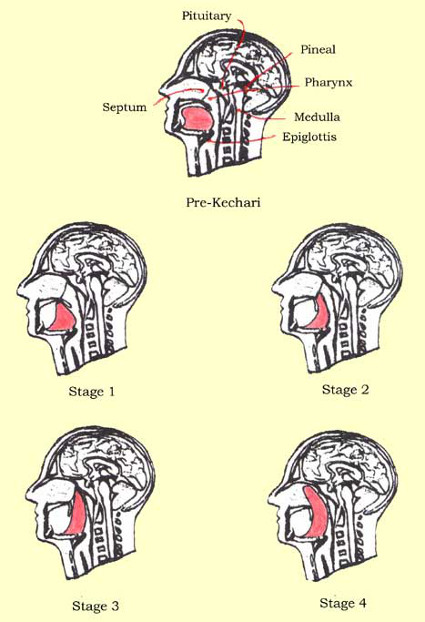
We will cover four stages of kechari here (see Image above), all pertaining to the location of the tip of the tongue:

Stage 1 – To the point on the roof of the mouth where the hard and soft palates meet. This is the line of demarcation that must be crossed before stage 2 can be entertained.

Stage 2 – Behind the soft palate and up to the nasal septum. It is a short trip, but a momentous one. Initially this is done with help from a finger pushing back under the tongue, going to the left or right side of the soft palate where entry is easiest. This may require "breaking the hymen" of the membrane under the tongue. See below for more on this.

Stage 3 – Gradually working to the top of the nasal pharynx and septum. This takes us to the bony structure containing the pituitary gland.

Stage 4 – Entering the nasal passages from inside and moving upward beyond the top of the pharynx toward the point between the eyebrows. It is not as far for the tongue to go as it seems. Put your thumb on the hinge of your jaw and put your index finger at the tip of your tongue extended straight out. Then pivot the fixed length to your index finger up on your thumb to the point between your eyebrows. See? It is not so far for the tongue to go straight up from its root.

In these lessons we view the frenum as a tether to be trimmed back when the time is right. It keeps us out of kechari until we are ready. When we are ready, and each of us knows when that is, the frenum can be trimmed. It is like a "hymen." When a woman is ready for sexual intercourse, the hymen goes. Until then it serves to provide protection. This breaking of the hymen can be a stressful and painful event if it is forced. Sooner or later the frenum will be forced open too, because going into kechari is as natural as going into sexual intercourse. It is biologically preordained. It happens when the nervous system is mature enough. Advanced yoga practices bring us closer to the transition with each day of daily practices.

In terms of my own timeline, I started with stage 1 in 2003 but had no interest in moving to stage 2 until 2012, then after about a month of Talabya Kriya I was able to push my tongue with my fingers into stage 2, and I did not have to trim my frenum as Yogani describes. In 2013 I achieved stage 3 and this year (2014) I achieved stage 4 and have begun practicing Nadi Shodhana by using my tongue to block each nasal passage in turn. I generally use stage 3 for the Kundalini Kriyas and Golden Age Kriya.

Tuesday, October 14, 2014

Kriya Yoga Freedom Fighters

I'm often told that I have violated Kriya Yoga secrecy by publishing my videos on YouTube. The reason for the secrecy is based on the idea that a student must attain the right level of advancement before a particular technique would offer them any value, and more importantly, be safe for them to practice. This sounds reasonable, but who is qualified to judge that a student has reached the appropriate level? Upon reading Ennio's book and the experiences of many others, it is clear that this judgement has been lacking in many organizations.

It should also be clear that a person keeping a secret has power and control over any person wishing to learn that secret, essentially robbing them of their freedom and making them a slave. Does this sound like the behavior of an enlightened person? People wonder why God allows humans to torture and kill each other, and they ask, "Is this the act of a loving God?" Well, yes it is, because any intervention would turn those humans into slaves, and God is not a slave master, God is a freedom fighter. Freedom is love, and control is slavery. Ennio, and the other Kriya Yoga Freedom Fighters that have joined him, understand this.

For many years, Ennio stood alone in the fight, but now more and more people are joining the cause. Of particular significance is Swami Nityananda Giri, in the lineage of Swami Shriyukteswar Giri, and the first Swami to fully reveal almost all of the techniques in his book Kriya Yoga: Science of Life-force. Below is an excerpt where he shares his thoughts on Kriya Yoga secrecy.

Kriya-yoga has now become a household name among westerners and urban elites of India though people still do not have a clear-cut understanding of it. Though we find many books on Kriya-yoga the lack of clear exposition on its philosophy and practice is still felt very much. So many myths and mis­understandings are gaining ground regarding name and techniques. One of the reasons may be that present day masters of the tradition are more interested in teaching this in the west rather than in India. Though humanity is one and seekers from the west have equal rights, then in the same logic the seekers from India must not be neglected. A true master belongs to the cosmos.

The second reason is the secrecy involved in the techniques. The secrecy was introduced with a view that a precious gem cannot be sold in the open market thereby bringing the suspicion of genuineness and the danger of having fallen into the hands of undesirable and not-so-serious people. Again secrecy developed interest among the masses to learn and practice it. So the purpose of secrecy was not to hide but rather to give to the public. Another aspect we learn from history is that in the name of secrecy, the teachers of yoga and tantra have only helped in the extinction of the precious techniques for knowledge. This sometimes brings additions and alterations that are not in accordance with the spirit of the scriptures though additions and alterations, which facilitate progress and adhere to the teachings of scriptures, are always welcome.

Over the ages it has been seen that due to hiding the techniques distorted variations appeared and, particularly in the name of tantra, many practices diametrically opposed to spirituality were introduced and are still in practice giving a bad name to a system that has nothing to do with those things. But we have to see that we are now in a completely revolutionary age of information and technology, which was not even thought of twenty years back. Now due to the development of technologies and various other factors the techniques are no more hidden and it is not even possible to keep them hidden. Moreover the scriptures have already described these techniques. A reader will find how the scriptures describe these techniques in this book in general and on the fourth chapter of the book in particular. So question arises since the scriptures do not hide the techniques then why should a book written on the subject does not describe the techniques. Hence it is time to discuss rather than hide and a middle way is to be accepted to keep the balance. I know many masters and organizations will not agree with me but I tried to act according to my conscience. Readers are always advised to learn them not from books but from a master and those who do so from a book it is at their personal risk. The book is only to clarify and help.

I also discovered that Swami Nityananda Giri has recently created a YouTube channel, and I would like to wish him a warm welcome! Below is his video on Kechari Mudra.

Wednesday, September 3, 2014

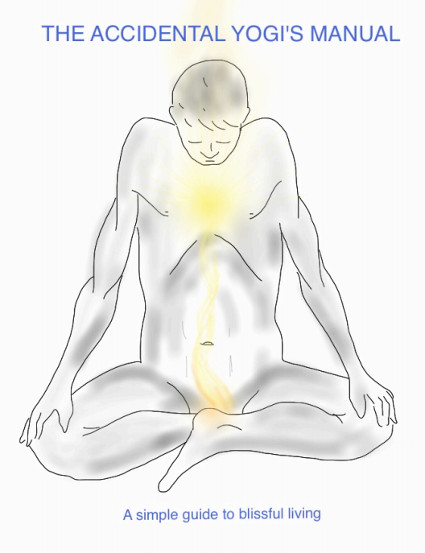
The Accidental Yogi

Kevin Curtis, owner of the blog "The Accidental Yogi", has written an interesting yoga manual with an emphasis on the physiology of the various mudras, bandhas and kriyas. I particularly enjoyed his description of Kechari Mudra.


Khechari has a powerful stimulating effect on the deep brain structures. In fact, of all the physical techniques used in yoga Khechari mudra has the strongest influence over our brain's neurochemistry. The reason for Khechari's powerful influence over the brain is due to the direct stimulation the tongue has upon five of the cranial nerves and the erectile tissues in the nasal cavity - the stimulation of which is directly linked to left and right brain dominance (which plays an important roll in the awakening process).

By inserting the tongue into the nasopharyngeal cavity (Khechari Mudra) you are stretching and lightly contracting the tongue, which stimulates the vagus, facial, glossopharyngeal, and hypoglossal nerves, all of which lead directly to the deep brain structures responsible for the release of the hormones used in the awakening process. By pressing your tongue against the nasal septum (the divide between your left and right nostrils) you directly stimulate the nasopalatine and lingual branches of the trigeminal nerve, another nerve whose stimulation causes the activation of our deep brain structures.

With all of this deep brain stimulation and the resulting release of mind altering neurochemicals going on we can see why Khechari has been thought of, by yogis for millennia, as being the king of the mudras. This simple, yet admittedly difficult to achieve, placement of your tongue can have a deeply profound effect upon your brain and the way it functions, and consequently on the way you see the world and act within it. In the short term all of this change going on in your brain can manifest as emotional highs and lows that you might not even notice, though people around you probably will.

Noticing these types of changes is a bit like being in an airplane, when you're in the plane it barely feels like you're moving, but to people looking up at the plane from the ground it's quite obvious that you're moving at great speed.

With all of these dramatic, life-altering changes happening it's interesting and reassuring to note that the practice of Khechari mudra also induces a comforting sense of non-attachment - as if you're just watching the process unfold before you.

Tuesday, August 5, 2014

AYP Site: Advanced Yoga Practices

Yogani has been practicing yoga since 1970, and recently (in 2003) he started sharing his knowledge via Yahoo groups. Today, all of his teachings have been collected at aypsite.org. He covers many aspects of Kriya Yoga such as Spinal Breathing, Navi Kriya and Kechari Mudra, and offers many insights that are not found elsewhere. I've begun reading through all of his lessons and highly recommend them. Here is an excerpt from his introduction:


We will be talking about many inward ways here -- the ways into the divine you. How to really open things up. Are you ready for that? Do you long for it? Not everyone does. But everyone will sooner or later. In fact, a little practice fans the fire of divine longing. Just a little bit of practice opens the door enough so that the divine desire wells up. Then we are on fire and want more practice and more powerful ways in. It is a kind of addiction -- a divine addiction. I confess to being an addict to this spiritual practice game. It is an ecstatic spiral that pulls us out of our limited earth perception. Everything will look different, first just a little, and later on, a lot different. So if you are not wanting to become divinely inspired, divinely addicted, better stay away. Because the best means are here. If you set your heart and mind to it, you can do it. Honest. And then nothing will ever be the same. You will laugh and laugh when you see how it really is.

This discussion is for wise souls, those who are ready to do what it takes for as long as it takes. Were the sages of old less committed than this? Of course not. We marvel at their remarkable stories in the scriptures. It is just the same now. You will get out of your practices what you put in. It has always been like that.

Why bother with all this? To be honest, it is the greatest high we can have. The pleasure is beyond anything on earth. Really. The essence of divine experience is unending devastating bliss and an unshakable silent peace. It seems contradictory, doesn't it? That's how it is. But don't take my word for it. Try some of these methods and see for yourself. It's all waiting in you. Take a few baby steps, and soon you can be opening by leaps and bounds. That is assuming you are ready, and choose each day to go for more. Remember, it is the one thing we can take with us when we move on from this life.

I will be examining Yogani's teachings in greater detail in future posts.

Monday, July 21, 2014

Tantra and Sexual Life

In my last post, I introduced the five M's of Tantra. In this post, I want to take a closer look at the fifth M: maithuna (sexual intercourse), or sexual life in general as I often receive questions on this subject. I will use Swami Satyananda's article on the subject as my reference.


Sexual life has always been a problem for mankind. From the beginning of history, the primal energy has been misunderstood. Religious teachers and moralists have denounced it. But still sexual life has continued, not because man respects it, but because he wants it. He may give it up, but he cannot remove it from his mind, for this is one of his most powerful urges.

I refer to this as a sexual craving. Some call it libido or sex drive, while others call it lust. So as I mentioned in my previous post, most spiritual paths would have you abstain from sex, meat, wine, etc., which in my opinion, only serves to intensify your cravings and distract you from your spiritual practice. The exact opposite of what abstaining was intended to achieve. In my experience it is much better to continue to satisfy your cravings, but when doing so, simply turn the mind inward and be aware.

The process is exactly the same as I had described in my post about food, since food cravings or sexual cravings or any other type of craving is all the same: slavery. By turning the mind inward and being aware you can transform your slavery into mastery, and when done during sex you will find your attention drawn to the experience of orgasm, as orgasm is a spiritual experience.


The natural event that takes place between man and woman is considered as the explosion of the energy centre. In every speck of life, it is the union between the positive and negative poles that is responsible for creation. At the same time, union between positive and negative poles is also responsible for enlightenment, and the experience which takes place at the time of union is a glimpse of the higher experience.

For most people the experience of orgasm lasts for less than a minute and they assume the best way to maximize the experience is to simply have sex often. The spiritual seeker on the other hand, realizing the connection to enlightenment, begins to wonder if the experience of orgasm can be extended to last for a longer period of time, or perhaps expanded to fill the whole body. Wikipedia even has an entry for the Expanded Orgasm:


Expanded orgasm, or a full body orgasm, is any sexual experience more intense and extensive than what can be described as, or included in the definition of, an ordinary orgasm. It includes a range of sensations that include orgasms that are full-bodied, and orgasms that last from a few minutes to many hours.

Again, most people are completely unaware that an orgasm can be made to last for many hours. Swami Satyananda also agrees that an expanded and extended orgasm is the goal for the spiritual seeker:


The energy waves that are created during the mutual union are not as important as the process of directing that energy to the higher centres. Everybody knows how this energy is to be created, but nobody knows how to direct it to the higher centres. In fact, very few people have a full and positive understanding of this natural event which almost everybody in this world experiences. If the conjugal experience, which is generally very transitory, could be extended for a period of time, then the experience of enlightenment would take place.

Swami Satyananda then goes on to describe what techniques can be practiced for achieving this. For men, the first step is to learn how to achieve an orgasm without ejaculating. Here he explains why this is important.


Ejaculation brings down the temperature of the body and at the same time, the nervous system undergoes depression. When the sympathetic and parasympathetic nervous systems undergo depression, it affects the brain. That is why many people have mental problems. When you are able to retain the semen without ejaculating at all, the energy in the nervous system and the temperature in the whole body are maintained. At the same time, you are free from the sense of loss, depression, frustration and guilt. Retention will also help to increase the sexual frequency, and that is better for both partners. The sexual act does not have to create weakness or dissipate the energy, on the contrary, it can become a means of exploding the energy. Therefore, the value of retaining the bindu should not be underestimated.

Holding back the ejaculation is achieved by contracting the urinary muscles, also known as vajroli mudra. This is then combined with moola bandha (contracting the perineum) for concentrating the energy. Then as the orgasm continues and the energy is maintained (rather than being dissipated) the concentration is moved up the spine and the energy flows with it to the higher chakras.

So while women don't experience ejaculation like men do, they do experience the same nervous system depression. Transforming that experience involves the same contraction of the urinary muscles, or sahajoli mudra, which is combined with moola bandha (contracting the vagina up to the cervix) for concentrating the energy. Then as the orgasm continues and the energy is maintained the concentration is moved up the spine.

The difference you will experience when you apply these techniques is quite profound. Even if you are only partially successful in your initial attempts, the difference in energy level is immediately recognizable. Some part of that orgasmic pleasure (or bliss) stays with you, and as your proficiency continues to increase you will notice a smaller and smaller difference between the peak of orgasm and your normal state of being.

Wednesday, June 11, 2014

Unconditional Love

Wikipedia defines Unconditional Love as love which has no bounds and is unchanging, so in the eyes of unconditional love there is no right or wrong, good or bad, or judgement of any kind. This is the most important thing to understand, know, remember, experience and become, and regardless of whether they know it or not, everyone is on the path to becoming pure unconditional love. The purpose of spiritual practice is to simply accelerate your journey along that path.

My introduction to yoga came in the form of Raja Yoga where the student is first taught to adhere to the Yamas and Niyamas. I rejected this notion, as even when I started, the strongest value I had was for freedom, and the yamas and niyamas seemed to be about taking away my freedom. Thankfully, I soon afterwards discovered Tantra, which has freedom as its core value, and I was in complete alignment with that.

For the beginner, Tantra starts out with Panchamakara where the practices include madya (wine), māṃsa (meat), matsya (fish), mudrā (parched grain), and maithuna (sexual intercourse). These are all things that the average person understands and likely consumes or engages in, but also mistakenly assumes excludes them from spiritual practice (as per the yamas and niyamas), but this is simply not true.

By turning the mind inward during the consumption/action of these five m's, spiritual knowledge is gained and spiritual advancement takes place. This is the beauty of Tantra, as it makes spiritual practice available to all.

In this post on diet, I explain how a natural evolution in diet takes place in conjunction with spiritual advancement, but even after reaching the breatharian state, your freedom is not limited, as you may still choose to consume wine or meat if you so desire without experiencing any negative effects. Trailanga Swami was famous for even drinking deadly poison without experiencing any negative effects.

Perhaps you are vegan and never consume alcohol, but with other friends you end up visiting the home of someone with a vineyard. The owner talks so passionately about his vineyard and the extreme care and attention he gives to growing his grapes and making his wine, that his love is clear for anyone to see. When he then offers a glass of his wine to you, what do you do? Do you look at the wine as if it is poison and refuse? Do you try to explain your spiritual goal of avoiding alcohol and then refuse? Do you lovingly accept it, but then pour it down the sink when no one is looking? Or do you lovingly accept it, drink it and savor every last drop, while imagining being filled with the love that went into growing the grapes and making the wine?

Certainly if you are going to be visiting the vineyard owner often due to perhaps a common interest in ecovillages, then you will need to explain your spiritual goals regarding alcohol, but is it appropriate to do so the first time you meet someone new?

During my first year of yoga practice (2001/2002), I followed the path of strict discipline and refused all food and drink I was offered, eating only what I had prepared myself. This behavior pretty much alienated almost everyone in my life. However, I did have many powerful experiences as a result, including being flooded with unconditional love in the summer of 2002, while meditating on the anahata kshetram.

I experienced a sensation of intense beauty that I reveled in for some time, and even though the experience seemed to refuse to end, I decided it was time to stop meditating. As I opened my eyes and began to move, I realized my shirt was soaking wet and I began wondering where the water was coming from. I soon realized it was dripping off my cheeks and chin, and that I was still weeping uncontrollably.

I got up and walked around, tried to think of something else, but this intense sensation of beauty, love, and joy that was making me weep, refused to leave. Finally, after about an hour, it abated, but I was forever changed. So while it was strict discipline that got me to this experience, it is unconditional love that has guided me ever since.

Thursday, May 22, 2014

Be Food Free

Swami Nithyananda has another interesting web site that I took a look at recently called Be Food Free. As regular readers of my blog will know, I believe that 15 to 30 million people will become "food free" breatharians over the next 15 to 20 years. This is a prerequisite for ascension (see my post Diet for Ascension), so I find it interesting that Swami Nithyananda is also working towards making this happen.

Once again, Swami Nithyananda is fairly open regarding the technique for becoming food free.


What is Nirahara Samyama?

Samyama means exploring and discovering your various possibilities and powers being centered on certain technique or spiritual process. Nirahara Samyama means exploring and discovering our body's possibility without having any external input like food or water.

The purpose of the Samyama is to awaken our own natural intelligence of making food out of natural resources like sun rays, air and the praana which is directly available to us from the space. Swamiji says if fish can swim, we can swim, if bird can fly, we can fly and if plants can make food directly from the air and sun rays, our body can also do that. Every extraordinary capability and possibility is inside our bio memory.

When our bio memory is awakened, we don't need a will. We just like that feel highly energetic and highly feeling excited. Mainly we get liberated from many patterns that got created with food. Every human being associates his fears, greed, attention need and idea of love with food. All patterns associated with love and attention need is connected with food. Food is a very emotional zone. Now when we are liberated by master from food and patterns created by food, the first thing that will happen is the unnecessary emotions and sentiments associated with food will break. So the reasonless excitement, kind of subtle joy will be constantly happening in our system.

Technique (EFU):

eN-Chanting - Ajapa japa
Feeling Connection - Mahabhava
Unclutching - Sahaja Samadhi

Ajapa Japa is one of the most powerful process and technique. It releases certain kind of energy from our body, nectar from the throat. Shakthi sanchaalana happens through Ajapa Japa means constantly the Kundalini is awakened but never allowed to go out of the body and it stays inside the body. Japa means just the voice coming from the naval through the throat and tongue and leaving, a continuous linear movement of air getting converted to sound is Japa. In Ajapa Japa, the Guru Mantra: "Oh Hreem Nithyanandaya Namaha" mantra is repeated constantly with the visualisation of the mantra moving in circular direction around the throat. A prayer wheel with the mantra written in it will help in Ajapa Japa in the initial levels It helps in getting inside our inner space and unclutching becomes easy. Feeling connection - meditating on the Anandha Gandha Chakra remembering the master, being in Bhakti, the joy of looking for him and remembering him. Unclutching - Being an observer of all the thoughts that arise by just witnessing them, neither encouraging them nor suppressing them.

I had practiced Japa seriously back in 2008 while working through the Systematic Course book and the experience I had was similar to what's described "Kundalini is awakened but never allowed to go out of the body". After about a month of practice, I experienced a sudden surge that filled my stomach. I couldn't eat for 3 days and only sipped water. I didn't feel the slightest bit hungry (I felt full in fact) and had plenty of energy, but discontinued the practice as I still had many more lessons to try out in the book, and after the aforementioned 3 days, the energy dissipated and my appetite returned to normal.

I've started practicing again according to Swami Nithyananda's instructions and have found them to be very effective. Most important is visualizing your mantra moving in a circular direction around your throat, passing through the Vishuddhi kshetram and chakra. The movement may be in either direction. The video below provides more details of the practice.


Sunday, February 2, 2014

Behind the Scenes

In my first video for Kriya Yoga Course 4, it appears as if I'm sitting outside in the snow, but I'm actually warm inside and have just superimposed myself onto the frozen lake behind my parents' house. This was accomplished by placing a green screen behind and under me when filming inside and then using software to replace the green with the background image. I purchased a Cowboystudio Chormakey Green 9 x 15 ft Muslin Backdrop for this purpose.

Separately, I went out onto the frozen lake and shot the footage for the background. We had shovelled the snow off part of the lake for the kids to skate on, so this is where I filmed. I'll also mention that I purchased a new Canon VIXIA HF R30 Full HD Camcorder which films at a resolution of 1920 x 1080, which is far superior to my old camera's resolution of 720 x 405.

After filming all of the footage and transferring it onto my computer, I noticed that the playback was very choppy as my old computer couldn't handle the HD picture resolution, so I then had to purchase a new computer too. This was turning into a more expensive venture than I had anticipated, but I was able to find a Lenovo G505s 15.6-Inch Laptop (Black) on sale which was able to play the HD footage smoothly.

I now needed some software that could produce chroma key green screen effects. I had been using the free tool Avidemux for some simple editing of the footage from my old camera, and while it worked great it didn't have a chroma key function. After searching a bit I discovered another free tool called Wax 2.0 which could do the job. Upon trying to load my video footage, it immediately crashed. I eventually figured out it only supported the wmv file format. After converting my footage, and then trying to apply the chroma key effect, it crashed again. I eventually figured out that if I removed the sound from my footage, the tool would finally produce the chroma key effect I was looking for.

It was quite a painful process for just this one function, so in the end I decided to buy PowerDirector 12 Deluxe which works really well, and I would highly recommend it to anyone wanting to create more professional looking videos. It supports many file formats, has many special effects features in addition to chroma key, however, I discovered that when I mixed chroma key with fades the end result was a bit choppy. To solve this, I had to create an intermediate video which just applied the chroma key effect, and then used that video to create another video which added the fade in/out effects on scene changes, along with beginning and ending titles. My video footage was now complete.

The soundtrack was another story. Many people had complained to me about the low audio level in my videos, so I was eager to solve this problem. The soundtrack editing and mixing features in PowerDirector are pretty good, but in this case I found a free tool that was even better: Audacity. With just one click of the "Compressor Effect" the audio level in the entire soundtrack was raised to an optimal level without causing clipping.

Finding music for the soundtrack was far easier than I expected. From within PowerDirector I was able to search for sitar music, listen to different samples, then directly add the one I liked to my video. However, mixing the music with my voice was most easily done with Audacity. In this case I used the "Auto Duck Effect" which automatically lowers the music volume level when I'm speaking. I exported the video with the mixed soundtrack to my computer and was quite pleased with the final result.

All I had left to do now was upload my video to YouTube. PowerDirector will do this for you automatically, so I expected this to be a breeze, but my first attempt caused PowerDirector to crash. I suspected I was again trying to have PowerDirector do too many things at the same time, so instead of loading my project file, I imported the finished mp4 video and tried again. This time it looked like everything was working, except it got stuck at 100% complete and eventually spit out an error saying the upload failed. I tried to directly upload my mp4 file, but YouTube complained about that format. Using PowerDirector, I tried converting the file into different formats until wmv finally worked. The quality is not as good as the original mp4, but the video is now finally up at YouTube. Check it out below. I have also made the original mp4 available at Sellfy to download for $0.95.

Lastly, I just wanted to thank everyone that has sent me donations, either here at my blog or at my YouTube channel. I'm currently just collecting the money, but once I have enough I'll set up a non-profit dedicated to spirituality and sustainability. Thank you with all my heart.

Wednesday, January 1, 2014

Kundalini Syndrome

I'm often asked if Kriya Yoga is dangerous. So just like driving a car or anything else, it isn't dangerous if you learn it thoroughly and practice it carefully. With a car, if you try to drive on a highway at high speed without first learning how to maneuver at low speed, you will increase your probability of having an accident, or if you are sleepy or there is bad weather or you are being distracted by a passenger or many other situations can also increase your likelihood of having an accident. Kriya Yoga is no different, just learn it thoroughly and practice it carefully and you will be fine.

I was motivated to write this post after reading JCS's and SNG's books on the original Kriya Yoga (as opposed to Swami Satyananda's variant), for I feel these books are lacking in terms of the necessary theory and practice required for someone to practice Kriya Yoga safely. These books give me the impression that any person off the street can start practicing Kriya Yoga directly without having any issues. In my opinion, this is akin to giving someone a million dollar supercar to drive on the autobahn at 300 km/h (190 mph) and expecting them to have no issues.

There are two types of problems I hear about from people practicing the original Kriya Yoga: either they have been practicing for a long time and have not experienced anything (i.e. they are stuck in 1st gear at 30 km/h since they never learned how to use a clutch); or they have had an extremely powerful experience that has left them feeling terrified (i.e. 300 km/h is way faster than they can handle).

The most important thing that anyone wishing to practice Kriya Yoga needs to know, is that it leads to Kundalini awakening, so before starting to practice you need to fully understand what that entails or you may end up with Kundalini syndrome instead (i.e. turning a positive awakening into a negative syndrome). Here is the list of possible "symptoms" from the Psychology Wiki:

The Physio-Kundalini Syndrome Index
Category Symptoms
Motor symptoms 1. Body assuming and maintaining strange positions for no apparent reason.
2. Body becoming frozen or locked into strange positions and immovable.
3. Breathing spontaneously stopping or becoming rapid, shallow, or deep for no apparent reason.
4. Spontaneous involuntary bodily movements.
Somatosensory Symptoms 5. Spontaneous deep ecstatic tickle or orgasmic feeling.
6. Physical sensations starting in the feet, legs or pelvis, and moving up the back and neck to the top of the head, down the forehead, over the face, then to the throat, and ending in the abdomen.
7. Extreme sensations of heat or cold moving through the body.
8. Moving pockets of bodily heat or cold being extreme enough to burn or otherwise affect someone else or an inanimate object.
9. Pains in specific parts of the body that begin and end abruptly.
10. Tingling, vibration, itching or tickling on the skin or inside the body.
Audiovisual symptoms 11. Internal noises, such as whistling, hissing, chirping, roaring or flutelike sounds.
12. Internal voices.
13. Internal lights or colors illuminating parts of the body
14. Internal lights bright enough to illuminate a dark room.
Mental symptoms 15. Observing oneself, including one's thoughts, as if one were a bystander.
16. Sudden, intense ecstacy, bliss, peace, love, devotion, joy, or cosmic unity.
17. Sudden intense fear, anxiety, depression, hatred or confusion.
18. Thoughts spontaneously speeding up, slowing down, or stopping altogether.
19. Experiencing oneself as physically larger than the body.

The second thing you need to understand is that these are not symptoms of a syndrome that needs to be cured, these are positive spiritual experiences that are working to cleanse and purify your body, mind and spirit and eventually lead you to enlightenment. This is why you are practicing Kriya Yoga: to achieve Kundalini awakening and enlightenment.

The third thing to understand, is that with proper preparation you can significantly reduce the severity of your Kundalini awakening experiences. Swami Satyananda has devised a systematic approach to cleanse and purify the body-mind-spirit complex in preparation for Kundalini awakening. I've covered this in my Kriya Yoga Course 1 and 2. First, Hatha Yoga must be practiced to open the spiritual pathways (nadis) in the body; second, Pranayama (i.e. Nadi Shodhana) must be practiced to balance the flow of spiritual energy (prana) in the pathways; finally, each of the spiritual centers (chakras) must be awakened individually. This will provide a milder experience of the table items above, allowing one to become accustomed to spiritual experiences without being overwhelmed by them.

Only after all of the previous steps have been taken is it then safe to practice Kriya Yoga in my opinion. However, you may still notice that your mind wanders or your body fidgets with the original Kriya Yoga, and this may be due to being unable to achieve the advanced form of Kechari Mudra (i.e. inserting the tongue into the nasal cavity). If this is the case, then I would recommend Swami Satyananda's Kundalini Kriyas (my Kriya Yoga Course 3) instead of the original Kriya Yoga, as you are pretty much guaranteed to experience the powerful flow of Kundalini in your spine with his Kriyas in my opinion.

After all of this you may be wondering if I find any value in the original Kriya Yoga. Well, I do, for after Kundalini awakens the journey is still not over, for enlightenment still needs to be reached. This is when the original Kriya Yoga is most useful, for after inserting the tongue into the nasal cavity, it becomes easier to achieve the breathless state (see Ennio and Steve) and experience absolute stillness of body and mind.

Thursday, December 5, 2013

Kriya-yoga: The Science of Life-force

Swami Nityananda Giri has written an excellent book on the Kriya Yoga of Lahiri Mahasaya called "Kriya Yoga The Science of Life Force". This book contains very comprehensive information on the background theory of Kriya Yoga prior to delving into the practices themselves. It includes many scriptural references and a deep view of the preparation required for Kriya Yoga. Here is an excerpt from the start of the book.


The breath-based meditation "Kriya-yoga" is a familiar name after its reintroduction by Mahavatara Babaji to Lahidi Mahasaya and subsequent work of Paramahamsa Yogananda in the western world. Though many literatures are available but the lack of clear exposition on the philosophy and practices of this ancient spiritual science is still felt. The book, Kriya-yoga: The Science of Life-force tries to fulfill this want. This work vividly explains "the Knowledge of Life-force" known as Pranavidya, which forms the basis of Kriya-yoga citing from Vedas, Upanishads, Srimad Bhagavadgita, Yogasutras of Patanjali and many other ancient scriptures, and analyzes how the breath technique quiets the mind, brings equanimity and results in development of discriminating intelligence that answers the questions and purpose of human life. This also gives an understanding on our inner reading, the principles and practices form auspicious resolves, noble faith, self-effort and austerities from righteousness, yama, and observances, niyama, up to the transcendental state, samadhi, those form the appendages of this treatise, and describes how the breath-based practices and meditations described herein are necessary for a seeker to remain healthy and attain the Knowledge. The body principle, sarira tattva, is also anatomized using both biological and spiritual sciences to accelerate spiritual practice and to facilitate the understanding on life and death, gross to causal bodies, five sheaths, five vital breaths, three knots, seven energy centers and their working. The most important aspect for readers and seekers is that for the first time they will find the secret techniques of Kriya-yoga, viz., Nabhi Kriya, Khecari mudra, Guru Pranama, Hamsa, prana viksana, Mahamudra, Isvarapranidhana Kriya, Thokar Kriya, Jyoti mudra, Sambhavi mudra, and different techniques of meditation, e.g., Aum, twelve-lettered Vasudeva mantra, inner-matrka and outer-matrka meditations, etc. are revealed, and explained in details citing their illustrations in Upanishads and ancient yogic scriptures and enumerating the rationale and scientific approach behind such practices and benefits involved.

As you can see, the techniques described in this book are somewhat different from the techniques described by Ennio Nimis and J.C. Stevens. Below is a list from the table of contents.


Preparing the Gross Body Energization Exercises, Kriya Hatha-yoga, Suryanamaskara, Sithilikarana Vyayama, Yogasanas, Yoganidra
Nabhi Kriya
Khecari Mudra No Need to Cut the Frenum, Talavya Kriya
Guru Pranama
Hamsah Sadhana
Vyana Viksana
Om Technique, Om Kausalah
Mahamudra

Kriya Proper I The Kriya Technique, Kriya Meditation, Subtle Manifestations of Light, Sound and Vibration, Kriya-breath and Meditation Quickens Evolution, Arousing Prana/Kundalini by Kriya Practice, Paravastha, Experiencing a Breathless State
Jyoti Mudra
Sambhavi Mudra

Kriya Proper II, Thokar Kriya Meditation with Vasudeva mantra, Matrka Dhyana, Antarmatrka Dhyana, Bahirmatrka Dhyana, Jyoti Mudra in Second Kriya
Third Kriya Techniques
The Fourth Kriya